



Dynamice Balancing Test On Steel Spool Of Sheet And Strip Mill Machine
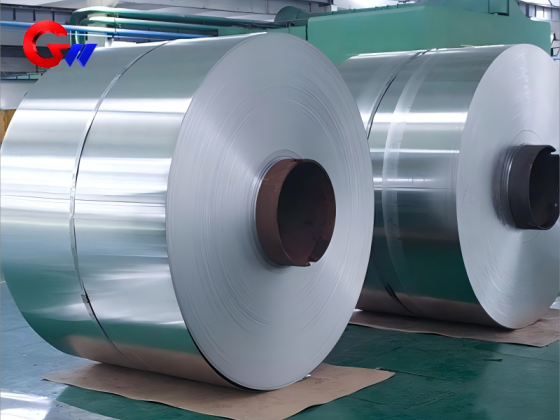
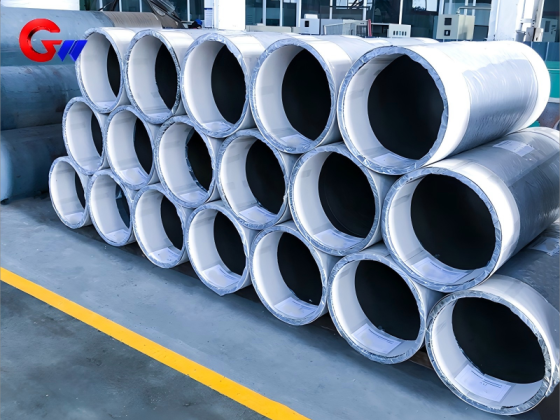
Steel Spools for Sheet and Strip Mill Machines are widely used in aluminum foil, aluminum plate, stainless steel foil and strip, and other sheet, plate and strip rolling applications. Because these components operate under high-speed rotation and alternating loads, strict requirements are placed on sleeve concentricity, dimensional accuracy and dynamic balance. GW Precision manufactures steel sleeve blanks by centrifugal casting and applies controlled machining and heat-treatment processes to meet the requirements of high-speed and high-precision rolling applications.
- GW Precision Technology Co.,LTD.
- China,Luoyang
- Contractual Stipulation
- Annual Capacity of Steel Spool is 4000 pieces
- Information
Dynamice Balancing Test On Steel Spool Of Sheet And Strip Mill Machine
Product Information
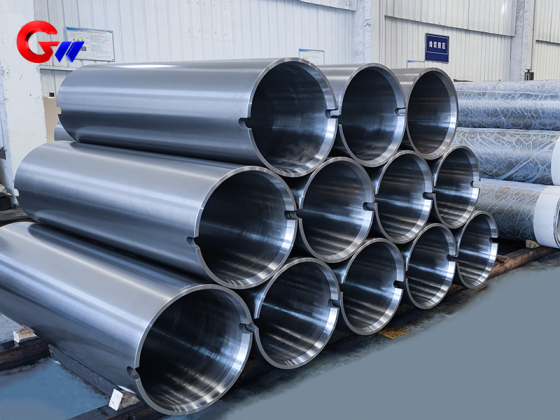
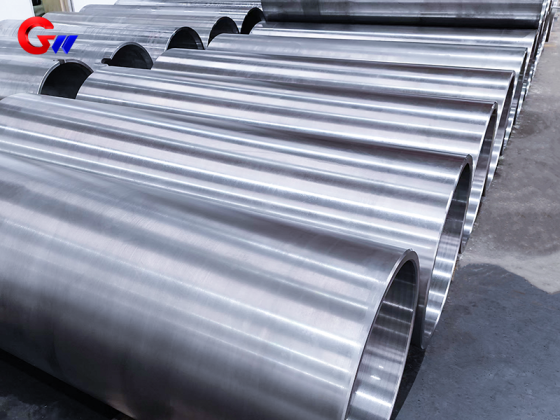
The steel spool of the sheet and strip mill machine is manufactured from 35CrMoV steel. One representative 35CrMoV steel sleeve has a specification of Φ554 × Φ504 × 1625 mm.
The 35CrMoV steel sleeve for sheet and strip mills, subject to dynamic balance testing, is an important component for high-speed and high-precision rolling. During operation, the sleeve needs to maintain dimensional stability and mechanical strength while withstanding alternating loads, impact vibration and continuous rotational forces. Therefore, material strength, wear resistance, machining accuracy, concentricity and dynamic balance are all important considerations in the manufacturing process.
Application of 35CrMoV Steel Sleeve in Sheet and Strip Mills
The steel sleeve can be used in roll systems of sheet and strip mills, including applications involving work rolls and support rolls. Typical rolling materials include stainless steel, carbon steel and copper-aluminum strip, with high-speed rolling conditions reaching a line speed of ≥10 m/s. Under these conditions, the sleeve is exposed to alternating loads and impact vibration generated by the rotating roll system.
For high-speed rotating equipment, dynamic balance is an important performance requirement. When the rotational speed exceeds 500 rpm, a dynamic balance test is required. The target residual unbalance is ≤1 g·cm/kg. Controlling residual unbalance helps reduce vibration during high-speed operation and helps avoid potential bearing failure and uneven sheet or strip thickness caused by excessive rotational vibration.
For high-precision rolling applications, the steel sleeve also needs to maintain dimensional stability during operation. A backing bearing sleeve used in six-high and 20-high rolling mills requires a roundness of ≤0.02 mm to support the accuracy of strip shape control. This requirement is particularly important for rolling systems where small dimensional deviations can influence roll positioning and the final product quality.
Centrifugal Casting and Precision Manufacturing
GW Precision obtains the blank of the steel sleeve for sheet and strip mill machines through centrifugal casting. Centrifugal casting is used to produce the initial sleeve blank before subsequent machining and heat-treatment operations.
For a large rotating sleeve, the relationship between the inner and outer surfaces is important to the final concentricity and dynamic balance of the finished component. Therefore, the manufacturing process needs to consider the complete production route from blank preparation through rough machining, stress relief, heat treatment, precision machining and final dynamic balance inspection.
The 35CrMoV material provides a combination of strength and toughness suitable for demanding rolling applications. The finished steel sleeve is manufactured according to the required dimensions and technical conditions, with machining and inspection focused on dimensional stability and rotational performance.
Heat Treatment Process of 35CrMoV Steel Sleeve
Heat treatment is an important part of the manufacturing process for the 35CrMoV steel sleeve. The core process is quenching and tempering.
For quenching, the material is austenitized and then oil quenched at 880–900°C. For large-section components, a water-quenching plus oil-cooling dual-medium quenching process can be used. The specified hardness after treatment is HRC 45–50.
After quenching, the sleeve undergoes high-temperature tempering. The tempering temperature is 600–650°C, with a holding time of 3–5 hours. This process is intended to obtain a tempered sorbite structure and achieve the specified mechanical performance, including tensile strength ≥1100 MPa and impact energy ≥50 J.
Stress Relief Annealing
After rough machining, stress relief treatment is applied to reduce machining-induced residual stress. The specified process is holding at 620°C for 4 hours. Controlling residual machining stress is important because dimensional changes caused by released stress can influence the final geometry and potentially affect the result of dynamic balance testing.
Optional Surface Strengthening
For applications requiring additional surface performance, ion nitriding can be used as an optional surface-strengthening process. The specified surface hardness is ≥HV1000, with a stated layer depth of 0.3–0.5 mm.
This treatment is applicable to cold-rolled sleeve applications and is intended to improve surface performance and reduce the friction coefficient.
Dynamic Balance Testing
Dynamic balance testing is a key inspection requirement for the 35CrMoV steel sleeve used in high-speed sheet and strip mill applications. As the rolling speed increases, even a relatively small residual unbalance can generate centrifugal forces and rotational vibration.
For applications with rotational speeds above 500 rpm, the sleeve is subjected to dynamic balance testing, with residual unbalance controlled to ≤1 g·cm/kg. This inspection is performed together with dimensional and machining controls to help ensure stable operation of the finished steel sleeve.
The combination of centrifugal casting, heat treatment, stress relief, precision machining and dynamic balance testing provides a complete manufacturing route for high-speed rolling sleeves. Concentricity and dimensional stability are particularly important because the sleeve operates as part of a rotating roll system. Maintaining the required geometry helps reduce vibration and supports stable rolling performance.
GW Precision Manufacturing Advantages
GW Precision has its own professional capabilities for product processing design, development and manufacturing, together with proven machining technology. The company has experience in manufacturing steel sleeves and related precision mechanical components for rolling applications.
GW Precision also has a well-developed management system, supported by highly qualified and skilled employees. Production management and process control are applied throughout manufacturing to support product consistency and technical requirements.
In addition, GW Precision has a management system supporting after-sales service, providing customers with continued technical and service support after delivery. The company follows a humanized management approach, promotes a cooperative working environment and aims to establish a win-win business platform through cooperation with customers and partners.
For sheet and strip mill applications, GW Precision can manufacture steel sleeves according to customer drawings, specifications and operating requirements. Material selection, sleeve dimensions, heat treatment, machining accuracy, surface strengthening and dynamic balance requirements can be considered according to the actual rolling application.
Conclusion
The 35CrMoV steel sleeve for sheet and strip mill machines is designed for demanding rolling environments where high rotational speed, alternating loads, dimensional stability and dynamic balance are important. With a representative specification of Φ554 × Φ504 × 1625 mm, centrifugal-cast blank, controlled quenching and tempering, stress relief annealing, optional ion nitriding and dynamic balance testing, the product is suitable for high-speed and high-precision sheet and strip rolling applications.
For rolling systems operating at ≥10 m/s, dynamic balance testing above 500 rpm with residual unbalance of ≤1 g·cm/kg, together with roundness control of ≤0.02 mm for applicable six-high and 20-high mill sleeves, provides important technical controls for stable roll-system operation.