

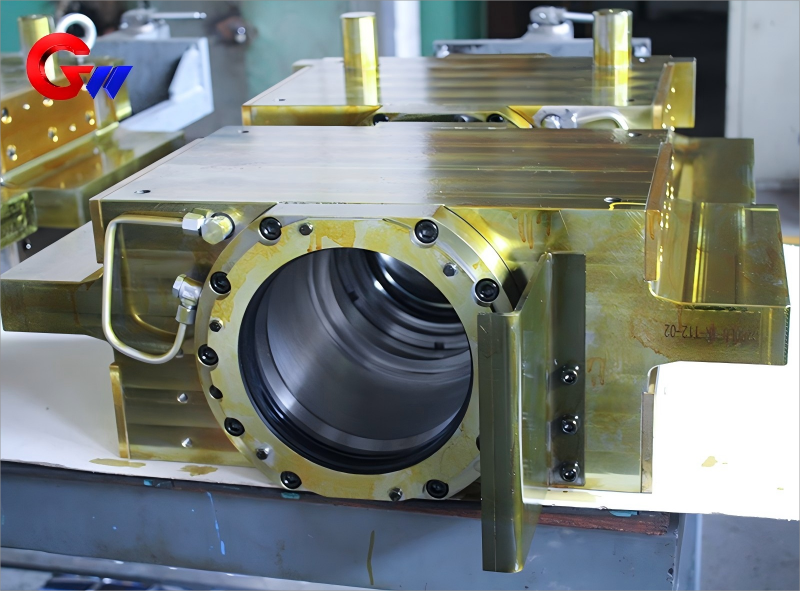
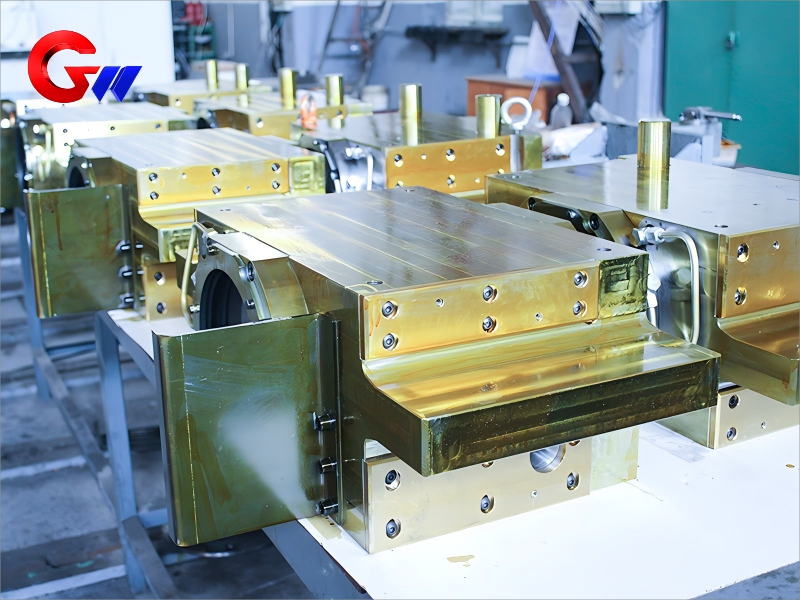

Support Roller Bearing Box on the Transmission Side of Hot Rolling Mill
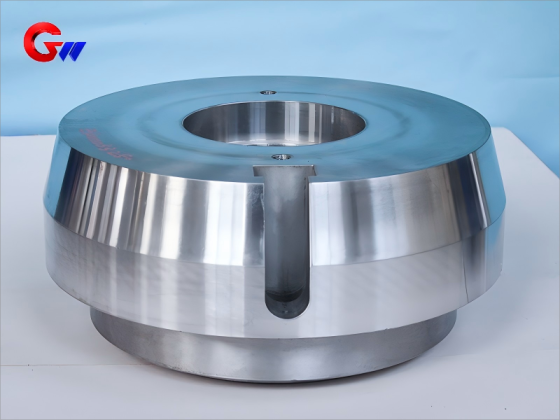
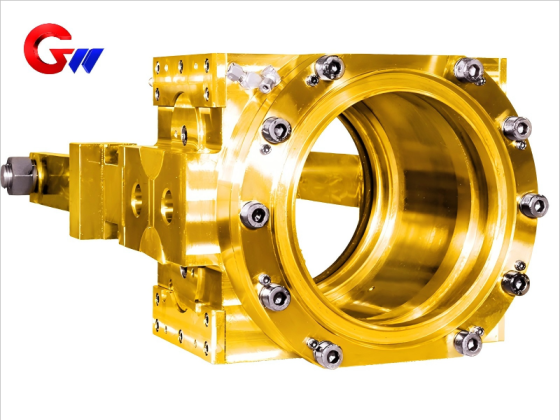
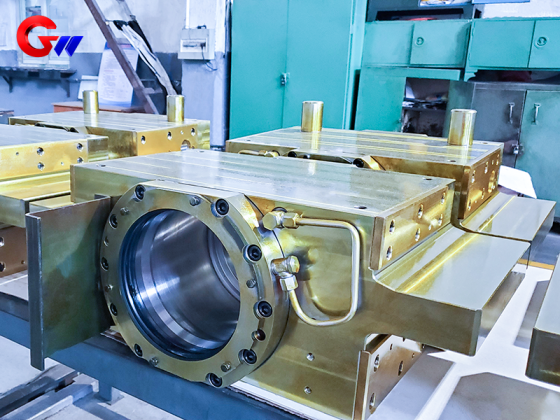
The support roller bearing box on the transmission side of a hot rolling mill is a heavy-duty structural component designed to support the backup roll assembly, transfer rolling loads to the mill frame, and maintain the required positional accuracy during continuous rolling operations.
The component is designed for demanding hot rolling conditions involving high rolling forces, repeated mechanical loading, thermal variation, and high-speed operation. Its main functions include heavy-load support, precise guidance of the support roller, bearing installation, and lubrication management.
The bearing box is designed to withstand a rolling force of up to 3,000–8,000 kN on one side and transmit the applied load to the mill frame. The support roller bearing interface is manufactured to maintain a specified radial runout of ≤0.03 mm, supporting stable roll positioning and strip thickness control.
An integrated oil-air lubrication system operates at 0.2–0.5 MPa and is suitable for hot rolling applications with rolling speeds of up to 15 m/s.
Brand: GW Precision
Product Origin: Luoyang, China
Delivery Time: According to contractual agreement
Supply Capacity: According to production requirements
- GW Precision
- China,Luoyang
- Contractual Stipulation
- Anual Capacity is 500 pieces
- Information
Application Conditions of the Transmission-Side Support Roller Bearing Box
The transmission-side support roller bearing box is primarily used in hot rolling equipment where the backup roll must operate under high mechanical loads and repeated rolling cycles.
During rolling, the support roller assembly transfers the rolling force generated between the work roll, strip, and backup roll into the mill housing. The bearing box therefore functions as an important structural connection between the bearing assembly and the mill frame.
The specified rolling force can reach 3,000–8,000 kN on one side. Under these conditions, the bearing box must maintain sufficient structural strength and dimensional stability while keeping the bearing and support roller correctly positioned.
The component is also required to operate under high-speed rolling conditions. With the integrated oil-air lubrication system operating at 0.2–0.5 MPa, the bearing arrangement can be supplied with controlled lubrication during continuous operation at rolling speeds of up to 15 m/s.
Heavy-Load Support and Load Transfer
One of the primary functions of the support roller bearing box is to provide reliable structural support for the backup roll bearing assembly.
During hot rolling, the rolling force is transmitted through the roll system and ultimately transferred into the mill frame. The transmission-side bearing box must therefore withstand significant compressive and dynamic loads without excessive deformation.
The specified load capacity is up to 3,000–8,000 kN per side. This operating requirement influences the selection of the bearing box material, heat-treatment condition, structural design, machining process, and dimensional inspection.
Maintaining the geometry of the bearing housing under load is important because deformation or dimensional deviation at the bearing interface can affect support roller alignment and the operating relationship between the backup roll and the mill stand.
For this reason, the bearing box is manufactured as a precision-machined structural component rather than treated only as a conventional cast steel housing.
Precision Guidance of the Support Roller
Accurate guidance of the support roller is another important requirement of the transmission-side bearing box.
The specified radial runout of the support roller is ≤0.03 mm. This dimensional requirement contributes to stable roll rotation and positioning during hot rolling and supports the required strip thickness consistency.
The bearing holes are therefore treated as critical functional surfaces during machining and inspection. Their concentricity, dimensional accuracy, and relationship with the installation surfaces directly influence the position of the bearing assembly.
For continuous rolling, stable bearing positioning can help reduce unwanted roll movement and maintain a consistent mechanical relationship between the support roller, bearing assembly, and mill frame.
The specified accuracy is particularly relevant to strip production where thickness control is important. According to the supplied application requirements, the equipment is intended to support strip thickness tolerance of approximately ±0.1%.
Oil-Air Lubrication System
The transmission-side support roller bearing box incorporates an oil-air lubrication arrangement for high-speed rolling applications.
The specified lubrication pressure is 0.2–0.5 MPa. Oil-air lubrication provides a controlled supply of lubricant to the bearing system while supporting continuous operation under high load and rotational speed.
For hot rolling mills operating at speeds of up to 15 m/s, lubrication management is an important part of bearing performance. Proper lubrication helps control friction and heat generation at the bearing interface and supports stable operation during extended rolling cycles.
The lubrication arrangement is integrated into the bearing box structure so that the relevant lubrication passages and interfaces can be manufactured and inspected as part of the overall component.
Compatible Hot Rolling Mill Applications
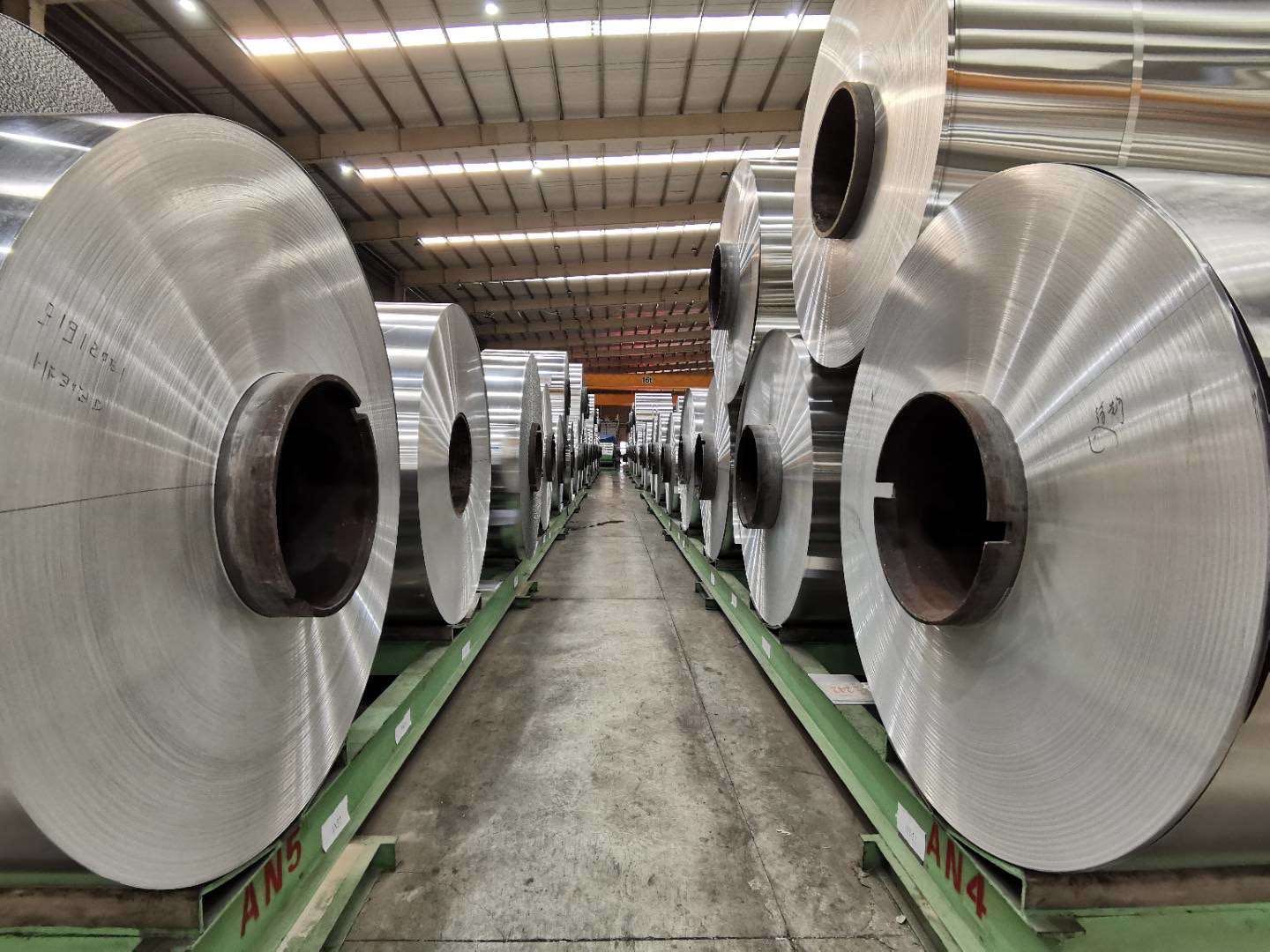
The support roller bearing box is suitable for hot rolling equipment including four-roll hot rolling mills and reversible roughing mills.
Four-Roll Hot Rolling Mill
The bearing box can be used in four-roll hot rolling mills for the production of carbon steel and stainless steel plates and strips.
Typical applicable strip thickness is:
2–25 mm
In a four-roll mill, the backup roll provides support for the work roll during rolling. The support roller bearing box is installed as part of the backup roll bearing arrangement and transfers the applied rolling load toward the mill frame.
The component must maintain dimensional stability and bearing positioning under continuous rolling forces while supporting the required roll alignment.
For carbon steel and stainless steel production, the bearing box therefore contributes to the mechanical stability of the backup roll system and the overall rolling process.
Reversible Roughing Mill
The component can also be applied to reversible roughing mill equipment.
The supplied operating condition specifies rolling-force fluctuations of approximately ±20%, reflecting the repeated changes in rolling direction and the associated dynamic loading.
Reversible roughing mills require structural components that can tolerate repeated impact and fluctuating loads without losing the required bearing alignment. The support roller bearing box must therefore combine adequate material strength, controlled machining accuracy, and stable installation surfaces.
Material Characteristics
The main material specified for the support roller bearing box is ZG35CrMoV cast steel with an optimized alloy composition.
The specified chemical composition is:
| Element | Specification |
|---|---|
| Carbon (C) | 0.30–0.38% |
| Chromium (Cr) | 0.8–1.2% |
| Molybdenum (Mo) | 0.2–0.4% |
| Vanadium (V) | 0.1–0.3% |
The alloying elements are selected to provide the mechanical properties required for a large structural component exposed to repeated rolling loads and thermal effects.
Chromium, molybdenum, and vanadium contribute to the strength and stability of the cast steel after heat treatment. The material selection is therefore coordinated with the expected load conditions and the dimensional requirements of the bearing box.
Material Performance and Heat Treatment
The ZG35CrMoV support roller bearing box body is quenched and tempered to obtain the specified hardness range.
The main material performance requirements include:
High-temperature yield strength: σ₀.₂ ≥450 MPa at 500°C
Thermal fatigue resistance: crack length ≤0.5 mm after 1,000 thermal cycles
The high-temperature yield strength is important because hot rolling equipment operates under significant thermal influence. The bearing box must maintain its structural properties when exposed to elevated temperatures associated with the rolling process.
Thermal fatigue resistance is also important for components exposed to repeated heating and cooling. The specified requirement of a crack length of no more than 0.5 mm after 1,000 thermal cycles provides a defined performance criterion for thermal durability.
Key Component Materials
Different materials and heat-treatment conditions are used for the major functional components of the bearing box assembly.
| Component | Material | Treatment / Hardness |
|---|---|---|
| Support roller bearing box body | ZG35CrMoV | Quenched and tempered, HB 260–300 |
| Wear-resistant lining plate | 42CrMo | Surface quenched, HRC 50–55 |
| Sealing ring | 304 stainless steel | Solution treated, HB 180–200 |
The ZG35CrMoV bearing box body provides the main structural support and load-transfer function. Its quenched-and-tempered condition provides the specified hardness range of HB 260–300.
The 42CrMo wear-resistant lining plate receives surface hardening to achieve a hardness of HRC 50–55. This treatment is intended for areas where wear resistance is required during service.
The 304 stainless steel sealing ring is solution treated and controlled within a hardness range of HB 180–200, providing the specified material condition for the sealing component.
Manufacturing and Precision Machining
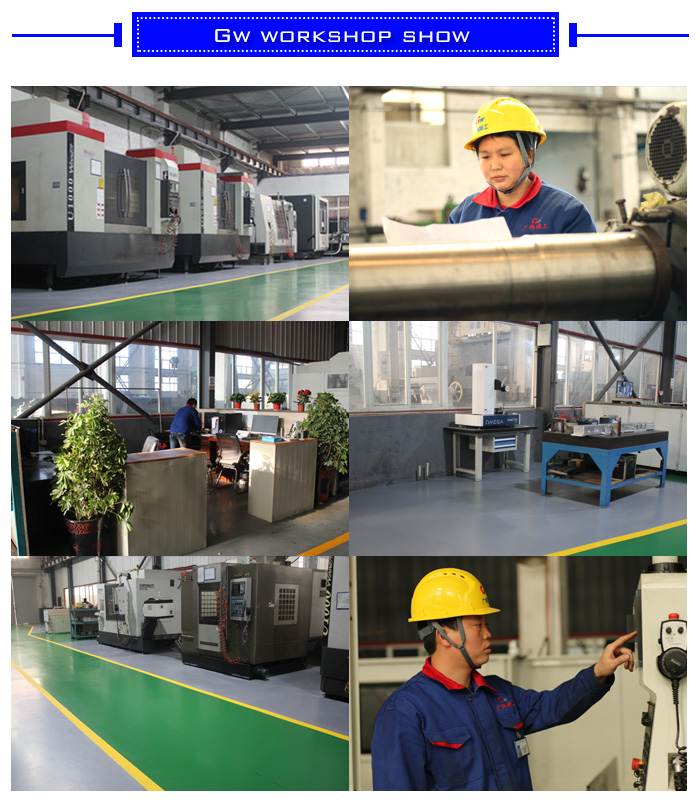
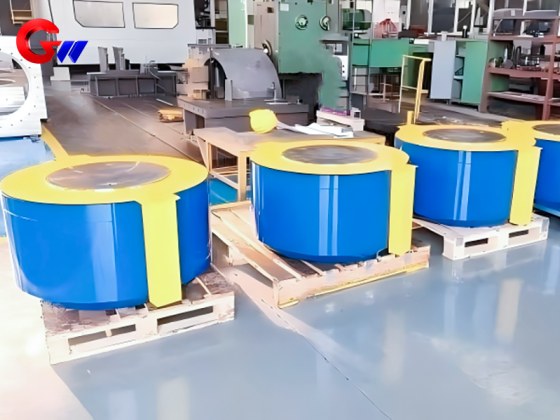
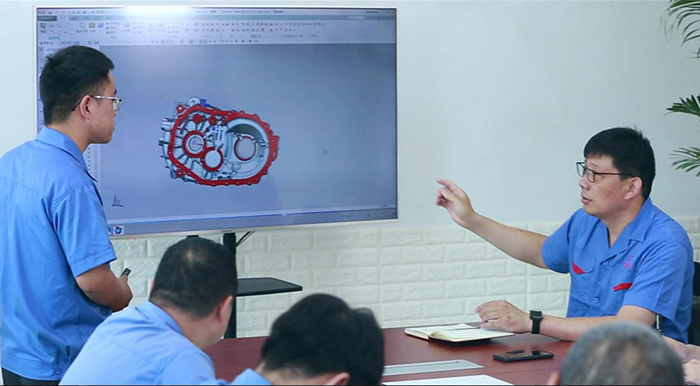
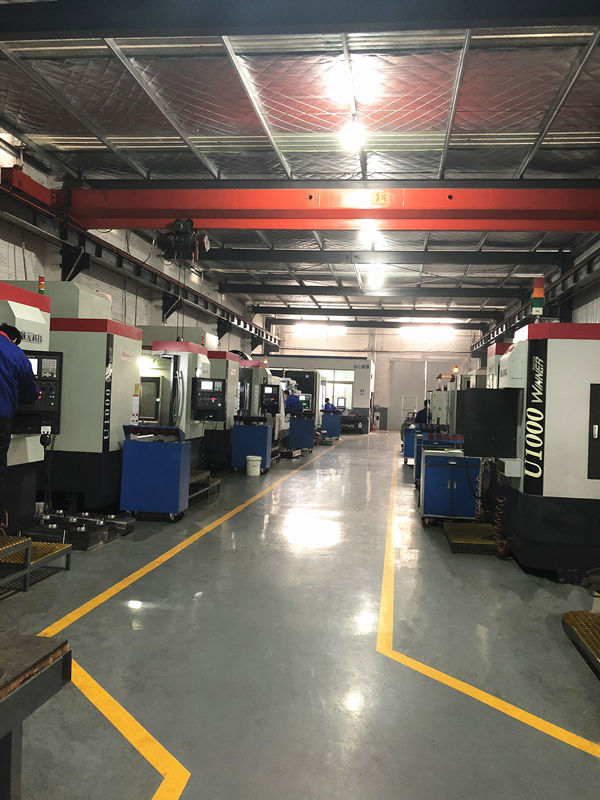
GW Precision has developed dedicated manufacturing capabilities for support roller bearing boxes through the application of large-scale machining equipment and process optimization.
The manufacturing equipment includes vertical machining centers, gantry machining centers, and horizontal machining centers. These machines support the machining of large bearing box structures and allow different machining operations to be coordinated within a controlled production process.
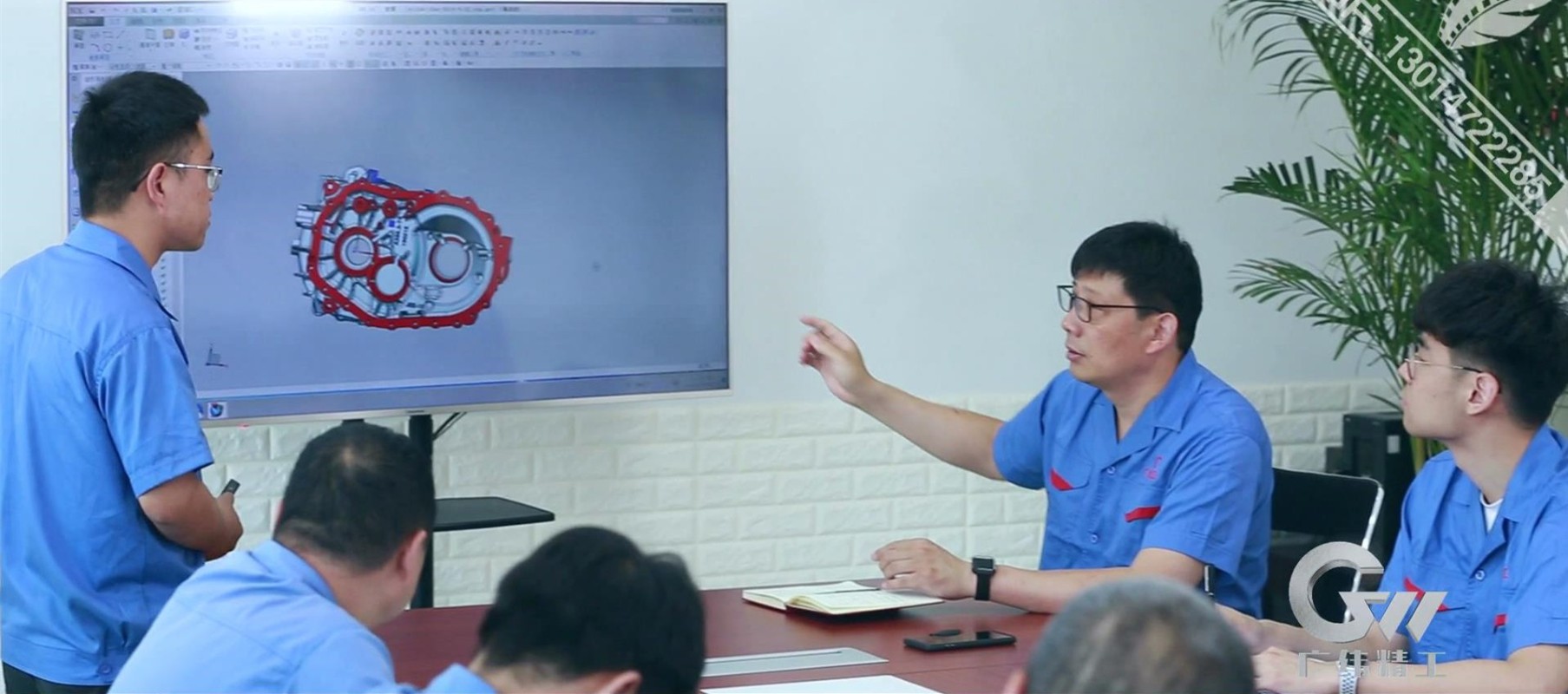
The company has also optimized machining programs and process planning through computer-based programming. The manufacturing sequence is organized according to the structural characteristics and precision requirements of the bearing box.
For a large hot rolling mill bearing box, machining accuracy is closely related to the position of the bearing holes, installation surfaces, and other functional interfaces. A controlled machining process helps maintain consistency between individual components and supports subsequent bearing installation.
The development of a mature bearing box machining process also helps improve manufacturing repeatability and overall processing quality.
Inspection Procedure and Quality Control
Inspection of the support roller bearing box covers material verification, non-destructive testing, dimensional measurement, and critical geometric accuracy.
Material Inspection
The chemical composition of the cast steel is checked through spectral analysis.
The specified requirement is:
Element deviation: ≤±0.03%
Inspection equipment: handheld XRF instrument
Ultrasonic testing is also performed to evaluate the internal quality of the cast steel.
The specified acceptance standard is:
EN 12680-3 Class 2
These inspection procedures provide material-quality verification before the component proceeds through the remaining manufacturing stages.
Dimensional and Geometric Inspection
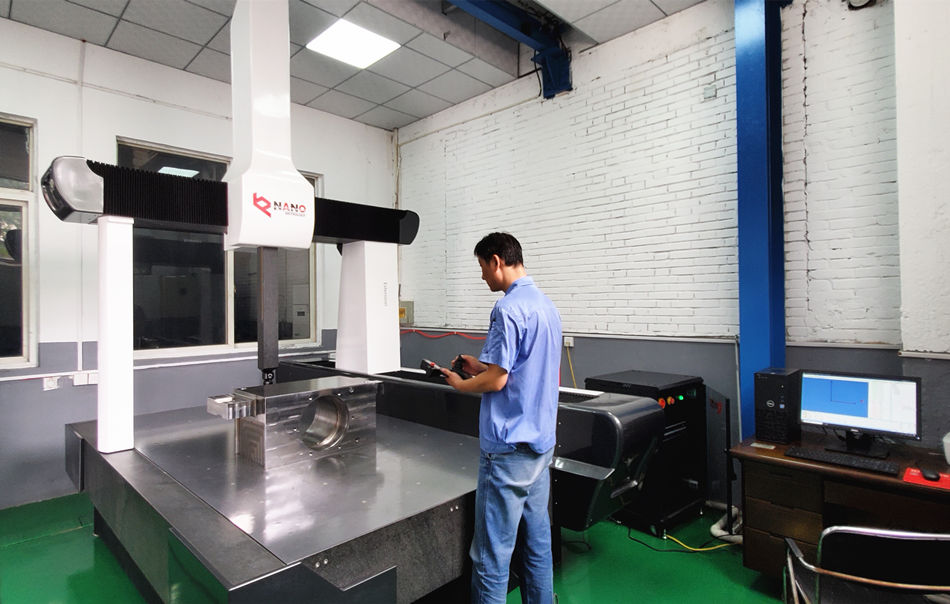
Critical dimensions of the support roller bearing box are inspected using precision measurement equipment.
| Inspection Item | Requirement | Inspection Equipment |
|---|---|---|
| Bearing-hole concentricity | ≤φ0.02 mm | Coordinate measuring machine |
| Installation-surface flatness | ≤0.03 mm/m | Laser plane interferometer |
Bearing-hole concentricity is controlled to ≤φ0.02 mm and inspected using a coordinate measuring machine. This parameter is important for maintaining the positional relationship between the bearing and the support roller.
Installation-surface flatness is controlled to ≤0.03 mm/m. Precision control of the installation surface helps ensure stable mounting between the bearing box and the related mill structure.
The combination of dimensional inspection and geometric measurement provides a basis for verifying critical interfaces before delivery.
Structural Reliability for Hot Rolling Applications
The transmission-side support roller bearing box operates as part of a load-bearing system rather than as an isolated component.
The bearing box must coordinate the functions of the support roller, bearing assembly, lubrication system, and mill frame. During operation, these components are exposed to rolling forces, vibration, thermal effects, and repeated mechanical cycles.
For four-roll hot rolling mills, the bearing box supports applications involving carbon steel and stainless steel strip and plate production in the specified thickness range of 2–25 mm.
For reversible roughing mills, the component is designed for operating conditions involving rolling-force fluctuations of approximately ±20% and repeated reversing impact loads.
These conditions place combined requirements on the bearing box material, heat treatment, machining accuracy, bearing-hole geometry, installation surfaces, and inspection procedures.
Manufacturing Capability of GW Precision
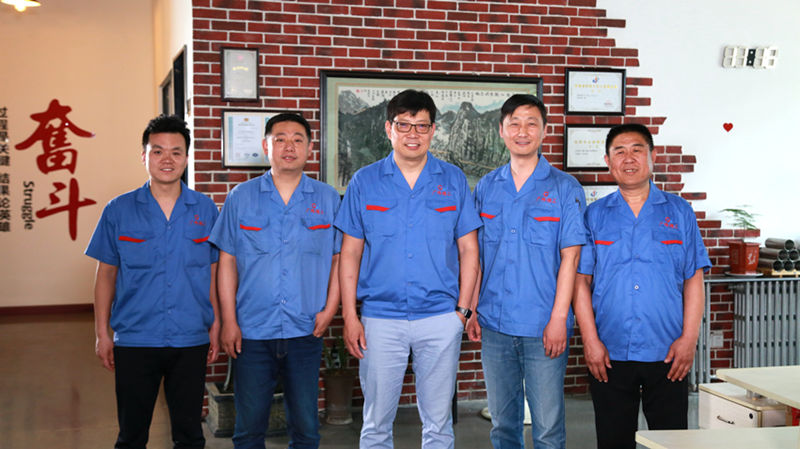
Support roller bearing boxes have become an important product category within GW Precision's manufacturing activities.
The company's production capability combines material inspection, heat treatment, large-scale precision machining, dimensional inspection, and quality control. The use of vertical machining centers, gantry machining centers, and horizontal machining centers supports the processing of large structural bearing components.
Through process planning and computer-aided machining optimization, the manufacturing process can be organized around the specific structural and dimensional requirements of support roller bearing boxes.
For hot rolling mill applications, the selection of ZG35CrMoV cast steel, controlled heat treatment, precision machining, bearing-hole inspection, and installation-surface measurement provides a coordinated manufacturing approach for transmission-side support roller bearing boxes.
For customized requirements, the component configuration and manufacturing parameters can be coordinated according to the customer's hot rolling mill model, rolling force, rolling speed, support roller arrangement, and installation requirements.